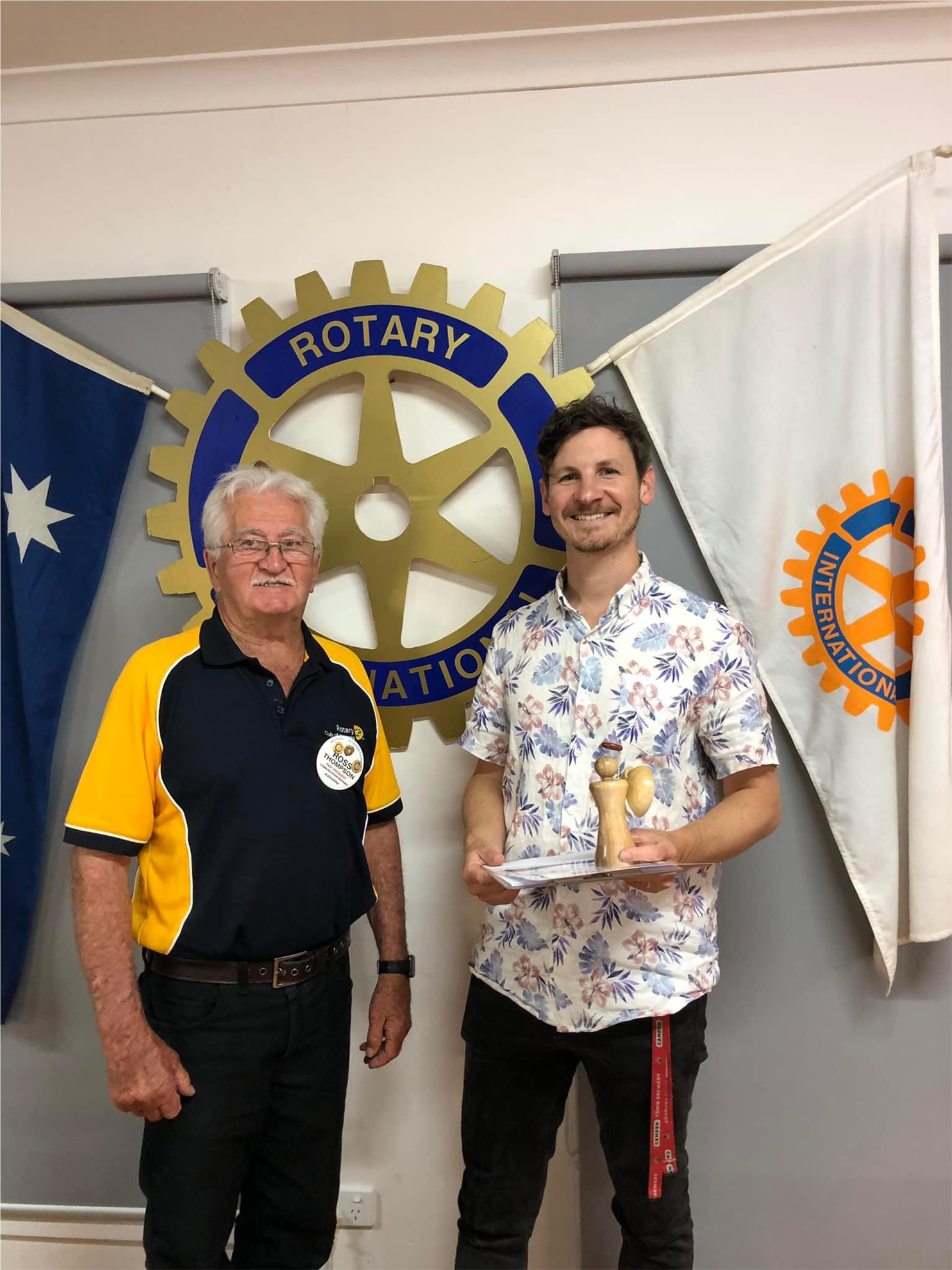
Alexandra Rotary’s guest speaker was Reece Bowman, Physiotherapist, Alexandra District Health. He has worked at ADH for 3 years, and has a total of 10 years’ experience, mostly in community settings. He escaped from Melbourne during Covid. HIs interests include ageing well, managing back pain with exercise, and pelvic floor dysfunction.
1 in 6 Australians experience back pain; it is the third leading cause of disability and has cost the economy $3.4 billion in 2019-20. Musculoskeletal disorders are COMMON, affecting 23% of the population. The spine comprises of cervical, lumbar and sacral vertebrae, terminating in the coccyx, with discs of cartilage between them. It is supported by the abdominal muscles (six pack) which act like a corset, by the ropey muscles of the back, the diaphragm (which moves the lungs) and the pelvic floor at the base. If the pelvic floor is not stable, it can lead to problems with bladder and bowel dysfunction.
Herniated or prolapsed discs can be associated with radicular pain such as sciatica extending down the legs. Osteoporotic fractures occur when vertebrae crush under their own weight with minimal impact. Commonest sign is loss of height with ageing, and 'dowager's hump curving of the spine'. Imaging is used to make diagnoses for clinical history, BUT the degree of pain experienced does NOT relate to the level of physical abnormality observed in medical imaging.
Reece's advice is that 'Exercise is not optional. It is an essential medicine/therapy which needs to be taken DAILY'. For those over 65, that means 30 minutes of moderate intensity exercise, most days. At this intensity it should still be possible to maintain a conversation, but the definition of moderate needs to be individualised.
A very informative talk relevant to everyone.
1 in 6 Australians experience back pain; it is the third leading cause of disability and has cost the economy $3.4 billion in 2019-20. Musculoskeletal disorders are COMMON, affecting 23% of the population. The spine comprises of cervical, lumbar and sacral vertebrae, terminating in the coccyx, with discs of cartilage between them. It is supported by the abdominal muscles (six pack) which act like a corset, by the ropey muscles of the back, the diaphragm (which moves the lungs) and the pelvic floor at the base. If the pelvic floor is not stable, it can lead to problems with bladder and bowel dysfunction.
Herniated or prolapsed discs can be associated with radicular pain such as sciatica extending down the legs. Osteoporotic fractures occur when vertebrae crush under their own weight with minimal impact. Commonest sign is loss of height with ageing, and 'dowager's hump curving of the spine'. Imaging is used to make diagnoses for clinical history, BUT the degree of pain experienced does NOT relate to the level of physical abnormality observed in medical imaging.
Reece's advice is that 'Exercise is not optional. It is an essential medicine/therapy which needs to be taken DAILY'. For those over 65, that means 30 minutes of moderate intensity exercise, most days. At this intensity it should still be possible to maintain a conversation, but the definition of moderate needs to be individualised.
A very informative talk relevant to everyone.